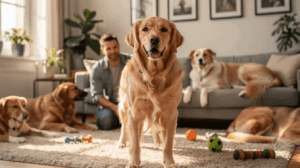
Living with multiple dogs adds complexity around food, toys, attention, doorways, resting spaces, walks, and visitors. These multi-dog household tips focus on management, individual training, safe introductions, and preventing conflict.
A calm home depends on predictable routines, enough space, supervision, and clear expectations. If dogs are injuring one another, attacking on sight, or cannot safely share space, professional or veterinary behavior support is appropriate.
Understand Each Dog as an Individual
Dogs living together may differ in age, health, energy, play style, confidence, training history, and interest in resources. A routine that worked with one dog may need to change when another joins the household.
The Merck Veterinary Manual explains that domestic-dog relationships are more complex than a simple pack hierarchy. Instead of asking which dog is “alpha,” watch for tension around blocking access, guarding food, crowding doorways, or competing for attention.
Pain, reduced mobility, hearing loss, or other medical changes may also affect how one dog responds to another.
Introduce New Dogs Gradually
Do not assume a new dog and resident dog will become friends immediately. When possible, begin in a neutral setting with one handler per dog.
Keep enough distance for both dogs to remain relaxed, and avoid forcing face-to-face greetings. Best Friends Animal Society recommends introducing a newcomer to resident dogs one at a time when several dogs already live in the home.
At home, remove high-value chews and food bowls, provide separate resting areas, supervise interactions, and use gates, crates, or rooms when separation is needed. Do not leave a new pairing together unsupervised until you understand how they interact.
Create Predictable Routines and Safe Spaces
Consistent routines make multi-dog homes easier to manage. Feeding, bathroom breaks, exercise, training, and rest can follow a predictable order without occurring at the same time daily.
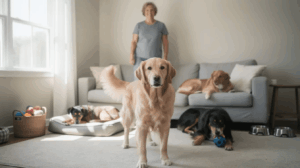
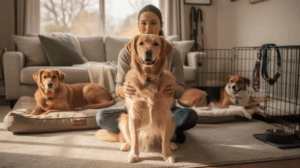
Each dog should have a comfortable place to rest without being disturbed. Options include separate beds, gated spaces, crates, or different rooms.
If doorways, stairs, gates, or hallways trigger excitement or tension, send dogs through one at a time, teach waiting behaviors, or use barriers during practice.
Train Dogs Individually Before Group Practice
Individual training lets you adjust difficulty for one dog at a time. Useful skills include name recognition, Sit, Down, Place, recall, loose-leash walking, waiting at doors, and Leave It.
Once each dog understands a behavior individually, another dog can become the next distraction. Greenville owners who want structured help can review dog obedience training programs.
Using a dog’s name before an individual cue can reduce confusion. For example, “Bailey, place” identifies who should respond. Karen Pryor Clicker Training also recommends distinguishing individual and group cues.
Build duration, distance, and distractions gradually. If performance falls apart when another dog joins, reduce the difficulty.
Manage Food, Toys, and Attention
Resource guarding is one possible source of conflict. Food, chews, toys, furniture, resting spots, stolen objects, and human attention can become valuable resources.
Separate feeding is a simple preventive strategy, especially with new dogs or any history of food tension. Feed dogs in separate rooms, behind gates, or in separate crates if they are comfortable there. Pick up bowls afterward.
Give high-value chews separately when needed, remove known triggers before group time, and do not force dogs to share. Merck’s behavior guidance for household aggression recommends preventing access to known aggression-triggering resources when affected dogs are together.
If one dog blocks another from approaching a person, use short, predictable turns and reinforce calm behavior rather than allowing competition.
Watch Body Language Before Conflict Escalates
Do not wait for a fight before recognizing tension. Warning signs can include freezing, stiff posture, hard staring, blocking access, hovering over an item, repeated attempts to leave, growling, lip lifting, or snapping.
Healthy play often includes loose movement, pauses, role reversals, and both dogs choosing to continue. Interrupt play when one dog repeatedly tries to escape or becomes overwhelmed.
If dogs actively fight, do not reach between them or grab collars with bare hands because redirected bites can occur.
When Professional Help Is Needed
Seek help promptly when bites break skin, fights become more frequent or severe, dogs attack on sight, one dog is chronically hiding, or safe household management becomes difficult.
A clinical study of 305 dog pairs presented for household aggression found that bites breaking skin, aggression on sight, and same-sex pairing were associated with poorer outcomes. This does not mean same-sex dogs are destined to fight, but it supports early intervention in higher-risk cases.
Greenville owners dealing with serious conflict can review current aggression and reactivity training and discuss whether professional support is appropriate.
Frequently Asked Questions
Should I Get Two Puppies at the Same Time?
It is possible, but raising two puppies requires more individual training, socialization, and separate experiences. “Littermate syndrome” is an informal term rather than a validated veterinary diagnosis. Each puppy should learn to train, relax, explore, and interact confidently without depending on the other.
How Long Does It Take for a New Dog to Settle In?
There is no standard timeline. Some dogs become comfortable quickly, while others need weeks or months. Watch whether both dogs can eat, rest, disengage, move through the home, and share space without increasing tension.
Can Aggressive Dogs Live Together?
Sometimes, but the answer depends on severity, triggers, bite history, health, and whether the dogs can be managed safely. Repeated bites, uninhibited attacks, or aggression on sight require a higher level of safety planning.
Final Takeaway
A peaceful multi-dog household depends on compatibility, predictable routines, individual training, safe spaces, gradual group practice, and thoughtful resource management.
Give each dog opportunities to rest, train, walk, and interact independently. Watch body language early, reduce competition around valuable resources, and do not force shared space when tension is rising.
For Greenville-area support, review current training programs and pricing or schedule a free consultation to discuss your dogs’ behavior, training goals, and household setup.