To teach a dog to heel, reward the dog for standing beside your chosen leg, then add one or two steps at a time. Mark and reward the correct position, gradually increase distance, introduce turns and pace changes, and practice around distractions only after the dog succeeds in easier settings.
A heel is more precise than loose-leash walking. Your dog stays close to your side and matches your movement until released. The American Kennel Club’s heel-training guidance starts in a quiet area, rewards the dog for finding position beside the handler, and then adds movement, turns, and attention.
Heel vs. Loose-Leash Walking
Heel and loose-leash walking are different skills.
During loose-leash walking, your dog may sniff, explore, and move within the leash as long as it remains relaxed. During heel, the dog stays in a specific position beside you and follows your pace and direction.
Heel is useful for short, controlled moments such as crossing a road, moving through a crowd, passing a distraction, or entering a building. It does not need to be maintained for an entire recreational walk.
What You Need Before You Start
Choose a quiet, low-distraction area. Use a comfortable leash, properly fitted collar or harness, small food rewards, and a marker such as “Yes” or a clicker.
The traditional competition heel is on the handler’s left, but pet dogs can learn either side. Pick one side and be consistent.
How to Teach a Dog to Heel
Step 1: Reward the Position
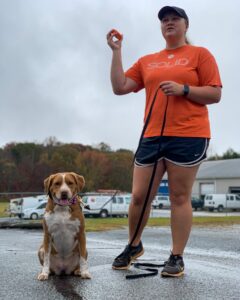
Stand still with your dog beside the leg you want to use. When the dog is in the correct position, mark the behavior and deliver the reward close to your leg.
Feeding beside you helps make that location valuable instead of encouraging the dog to move ahead.
Repeat until your dog begins returning to the position willingly.
Step 2: Add One or Two Steps
Once your dog understands where to stand, take one step forward. Mark and reward if the dog moves with you and remains beside your leg.
Build gradually from one step to two, then several. If your dog moves ahead, drifts away, or loses focus, reduce the difficulty instead of pulling the dog back into position.
Step 3: Add the Heel Cue
When your dog is consistently moving into position, add your verbal cue, such as “Heel,” immediately before you begin.
Say it once, move, and reinforce successful position rather than repeating the cue throughout the exercise.
Step 4: Add Turns and Pace Changes
Practice left turns, right turns, about-turns, faster walking, and slower walking. These changes teach your dog to pay attention to your movement instead of simply walking straight.
Keep early repetitions short and reward often enough that your dog understands what works.
Step 5: Add a Release Cue
Heel should have a clear beginning and end. Use a release word such as “Free” or “Okay” to tell your dog when the structured position is finished.
How to Add Distractions
Increase difficulty in stages. Practice indoors, then in a quiet yard or driveway, then on a calm sidewalk, and finally around harder distractions.
If your dog can heel indoors but immediately pulls outside, the skill is not necessarily lost. The environment is harder. Increase distance from distractions and return to shorter repetitions.
Greenville dog owners looking for professional help with heel training can explore the Advanced Obedience, Basic & Advanced Obedience, and Two-Week Board & Train programs offered by Off Leash K9 Training of Greenville. These programs list Heel among the skills taught. Review the current training programs and pricing to find an option that fits your dog’s age, experience, and training goals.
Common Heel Training Problems
Your Dog Pulls Ahead
Reward beside your leg rather than reaching forward with the treat. Shorten the number of steps and reinforce the correct position before the dog forges ahead.
Your Dog Lags Behind
Make the exercise easier and check whether the environment, equipment, surface, or physical comfort could be affecting the dog. Use encouraging movement and rewards rather than dragging the dog forward.
Your Dog Loses Focus Around Other Dogs
Increase distance. A dog that is barking, lunging, or unable to disengage may need a separate reactivity plan rather than more heel repetitions in the same setup.
Puppies and Heel Training
Puppies can begin learning to walk beside you through short, positive exercises. Expectations should remain age-appropriate.
Greenville’s Puppy Preschool includes introductory Heel among the commands that may be covered for dogs under five months.
When Professional Training Can Help
Professional guidance can help when pulling is difficult to manage, the dog becomes highly distracted outdoors, or heel training is part of broader obedience goals.
Greenville owners can review current training programs and pricing before choosing between private obedience instruction and immersive training. Program choice should depend on age, existing skills, behavior, and goals rather than a fixed timeline.
Frequently Asked Questions
Which Side Should a Dog Heel On?
The left side is traditional in obedience competition, but a pet dog can learn either side. Consistency is more important than choosing left or right.
How Long Does It Take to Teach Heel?
There is no universal timeline. Progress depends on training history, motivation, distractions, owner timing, and practice consistency.
Should My Dog Heel for the Entire Walk?
Usually no. Heel is best used when close control is useful. Loose-leash walking and appropriate sniffing can make up the rest of a normal walk.
Can an Older Dog Learn to Heel?
Yes. Adult and senior dogs can learn new behaviors, although physical comfort and mobility should be considered.
Final Takeaway
Teaching heel means making one position beside you clear and rewarding, then gradually adding movement and distractions.
Start in a quiet place, reward the correct position, add only a few steps at first, introduce the verbal cue after the behavior becomes predictable, and use a release cue when heel is finished.
For Greenville-area support, learn more about Off Leash K9 Training of Greenville, review the dog obedience training programs and current pricing, or schedule a free consultation to discuss your dog’s training goals.