Introduction
Puppy potty training typically takes 4 to 6 months for most puppies to reach full reliability, though basic progress (fewer accidents, beginning to signal) often appears within 2 to 4 weeks of consistent work. Some puppies in ideal conditions wrap up closer to 3 months; toy breeds, rescues, and puppies with inconsistent early environments sometimes need up to a year.
This guide covers realistic timelines broken down by age, the physical and behavioral factors that speed up or slow down house training, and what to do when progress stalls. It targets new puppy owners starting from scratch, and pet parents stuck in an extended training period wondering whether something is wrong. The content does not cover adult dog re-training or specialized indoor elimination systems for dogs with disabilities.
Most puppies require 3 to 6 months to become fully house trained. Basic progress, meaning fewer indoor accidents and early signaling, can appear within 2 to 4 weeks with a consistent daily schedule and positive reinforcement.
After reading this article, you will understand:
- Age-based milestones from 8 weeks through 12 months
- How breed size, training consistency, and environment change the timeline
- The specific setbacks that extend training and how to fix them
- When accidents signal a medical issue rather than a training gap
- How professional guidance can compress the learning curve
Understanding Puppy Potty Training Timeline Fundamentals
“Fully potty trained” means a puppy reliably eliminates only at a designated potty spot (outdoors or, if intentionally trained, on potty pads), signals when it needs to go, and maintains control during sleep, absence, and distractions with zero or near-zero accidents over weeks. Basic progress is different: a young puppy showing fewer accidents inside and beginning to sniff or circle before eliminating has learned where to go but lacks the bladder control and habit strength to do it without supervision.
The puppy potty training timeline depends on two parallel tracks: physical bladder development and learned behavior. Both must mature before a pup is reliably trained.
Physical Development Factors
Puppies younger than 16 weeks lack the neurological and muscular maturity to hold their bladder for more than short stretches. A puppy can generally hold its bladder for about one hour per month of age, so a 3-month-old puppy can hold it for about 4 hours under good conditions. This formula holds reasonably well up to around 9 to 12 months. Bladder control improves gradually as puppies mature; before 4 months, most puppies need to eliminate frequently, often every 1 to 2 hours during the day. Puppies cannot be expected to hold their bladders for an entire workday.
Nighttime control lags behind daytime control by several weeks. Many puppies sleep through the night without accidents between 4 and 6 months, once bladder capacity catches up to an 8-hour overnight stretch.
Learning and Habit Formation
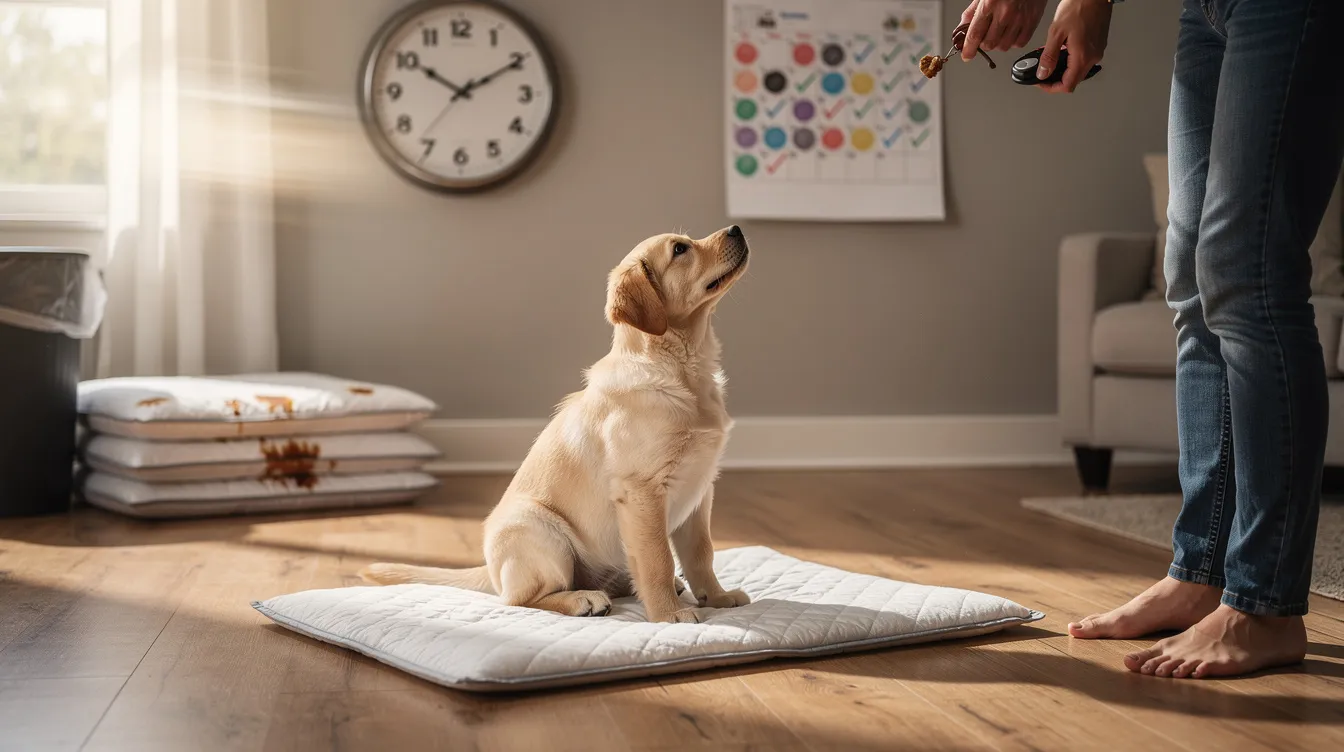
Puppies form associations between a specific location, a routine, and the act of elimination through repetition and reward. Training may involve taking the puppy to the same outdoor spot every time; over days and weeks, the puppy links that same area with the cue to pee or poop. Puppies learn faster with treats and praise after eliminating outside. Positive reinforcement should follow immediately after the puppy eliminates correctly, within 2 to 3 seconds of the behavior, so the pup connects the reward with the action rather than with walking back to the door.
Consistency in feeding schedules helps regulate a puppy’s elimination habits, making potty breaks predictable. Puppies thrive on routine for potty training success, and establishing a routine helps puppies learn elimination timing. The faster a household locks in a consistent schedule, the faster the puppy maps the pattern. This relationship between consistency and speed is the single largest variable dog owners can control, which leads directly to the specific factors that shape the full potty training timeline.
Factors That Impact Training Duration
Beyond the fundamentals of bladder development and habit formation, several concrete variables push the timeline shorter or longer.
Puppy Age and Breed Considerations
Puppies that begin training at 8 weeks, with a breeder who already introduced outdoor elimination or pee pads, tend to form associations faster than puppies acquired at 12 weeks or older with no prior structure. Rescue puppies adopted at 3 months with no previous routine often show accidents along major growth phases; owners of these dogs report that reliability emerges around 5 to 6 months when paired with crate training and a strict daily schedule.
Smaller breeds often require longer periods to house train due to smaller bladders. Toy breeds like Chihuahuas and Yorkies have higher metabolic rates and weaker early bladder control; their owners report needing potty breaks every 1 to 2 hours even at 4 to 5 months, and some toy breeds do not reliably hold through the night until 6 to 8 months. A Labrador Retriever puppy at 4 months, by contrast, typically manages 5-hour stretches during the day. Puppies previously confined to pads may need extra time to adjust to outdoor elimination, which can add weeks to the transition.
Training Consistency and Method Quality
Establishing a strict routine helps accelerate puppy potty training success. Puppies should go out every 30 minutes during active training periods, and always after meals, naps, and playing. Take puppies out after meals to regulate elimination. Consistent rewards help puppies associate pottying outside with positive outcomes.
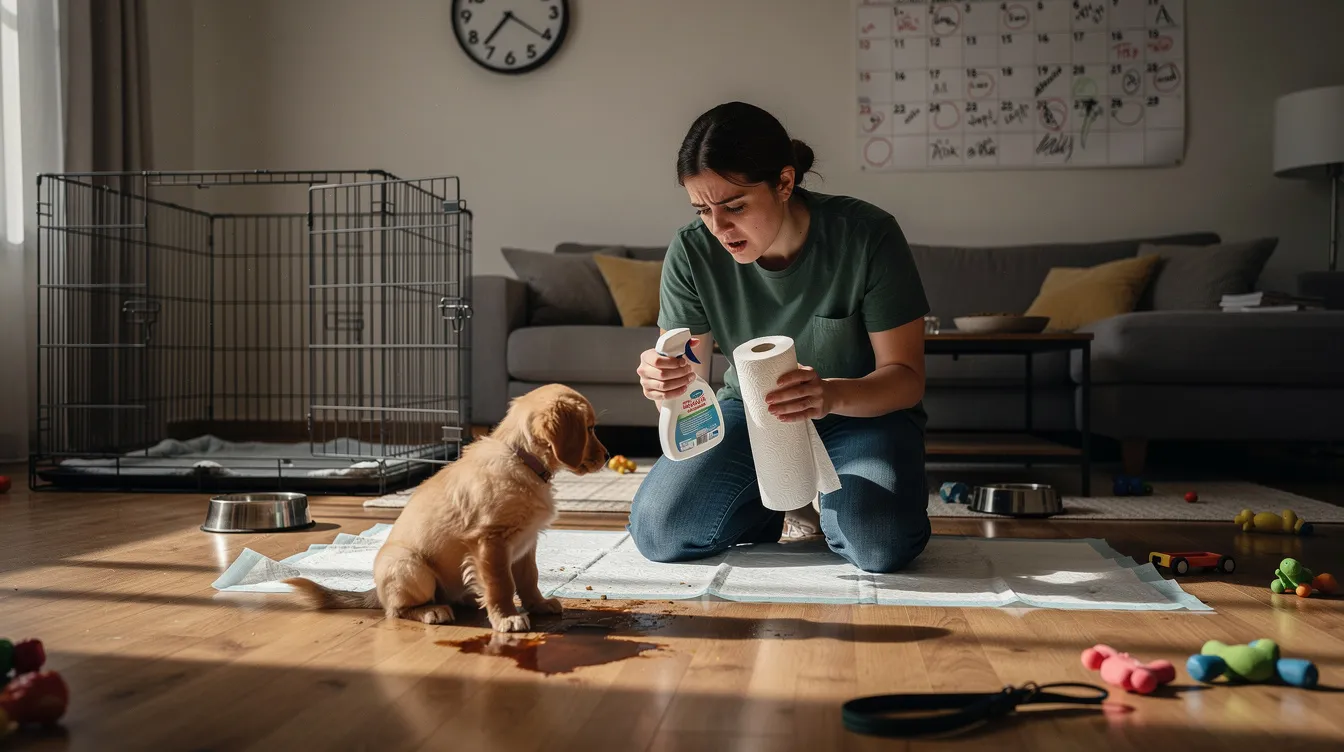
Positive reinforcement encourages desired behaviors in puppies. Avoid punishment to prevent fear and confusion during potty training. Puppies should not be punished for accidents indoors; doing so teaches them to hide elimination rather than seek the correct spot. Supervise your puppy closely to prevent accidents indoors, and if an accident happens, use an enzymatic cleaner to eliminate odors from accidents so the puppy does not return to the same area.
Using puppy pads can confuse the training process by teaching a puppy that indoor elimination is acceptable, which sometimes delays full outdoor reliability by weeks.
Environmental and Household Factors
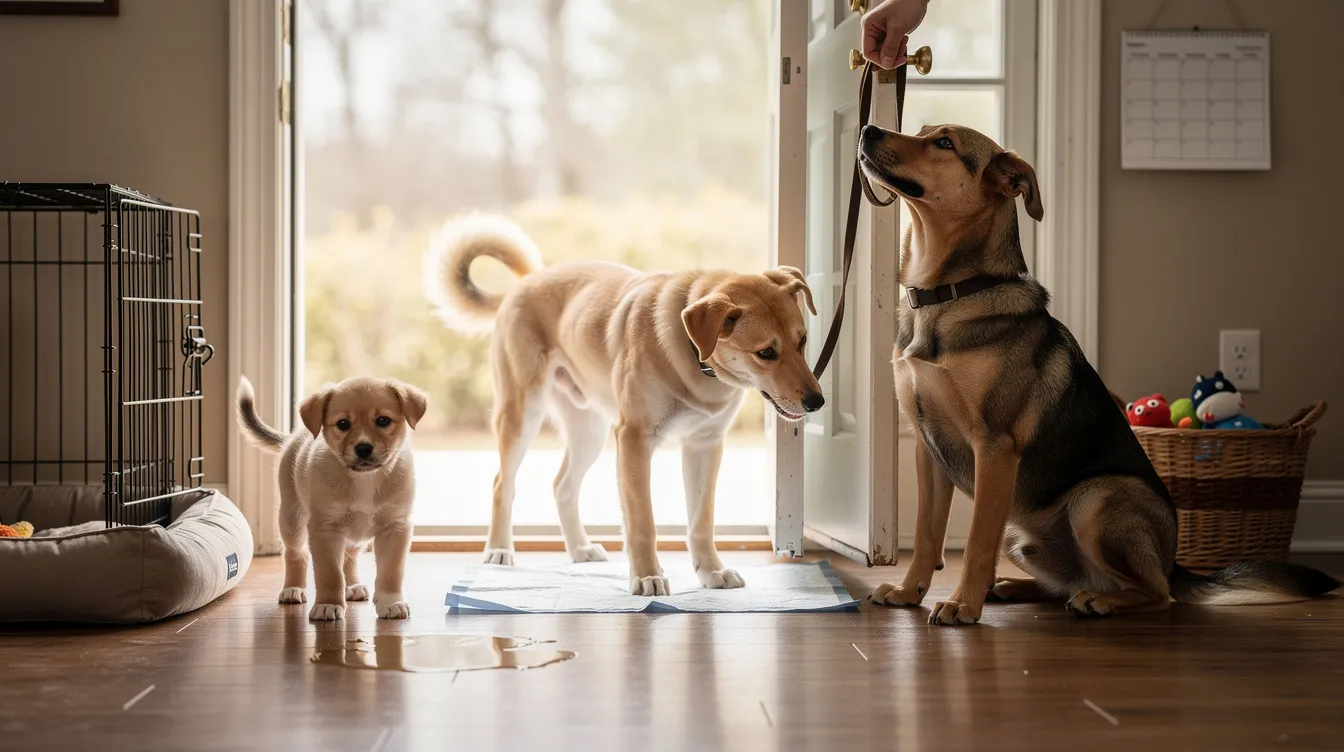
Multiple caregivers who use different cues, timing, or rules can delay training by weeks or months. If one person takes the puppy to the designated potty spot in the yard and another opens the door to the front porch with no direction, the puppy receives contradictory information about where to do its business.
Home layout matters. A puppy in an apartment on the fifth floor faces a longer trip to the outdoors than one in a house with a yard and a door open to a fenced area. Weather plays a role too: rain and snow discourage some puppies from wanting to go outdoors, slowing the habit loop. These environmental realities shape how quickly a puppy connects the routine to the location, which brings us to what specific progress looks like at each age.
Realistic Timeline Expectations by Puppy Age
The following milestones represent a puppy on a consistent schedule with one primary trainer, regular meals, and crate training. Puppies with less structure will fall behind these benchmarks.
8-12 Week Training Progression
Most puppies start training during this window, and the first one week sets the foundation. Frequent accidents are common during the initial stages of potty training; expect multiple per day. Most puppies can learn the routine in 7 days, meaning they understand where to go even if they cannot always get there in time.
Weeks 1-2: The pup goes to the same area outdoors every 30 minutes to 2 hours. You take your puppy out first thing in the morning, after eating, after naps, and after playing. Accidents inside are frequent. Puppies often exhibit signs like sniffing or circling before needing to go; ignoring signs that a puppy needs to go can lead to accidents. Crate training helps puppies learn bladder control by leveraging a puppy’s instinct not to soil its sleeping area.
Weeks 3-4: The puppy begins showing clearer signs before eliminating. Indoor accidents drop if supervision stays tight. The pup starts associating the potty spot with the cue word. You still need to supervise closely and take the puppy out on schedule.
Weeks 5-8: Reliability improves with supervision. The puppy holds it for 2 to 3 hours during the day. Occasional accidents still happen, especially during excitement or when the puppy explores new rooms in the house.
Weeks 9-12: A puppy at 3 to 4 months can hold its bladder for roughly 4 hours. Night control begins developing. Some puppies sleep 5 to 6 hours without needing a potty break. Daytime accidents become less frequent.
Timeline Comparison by Training Approach
| Factor | Consistent Schedule + Crate Training | Moderate Consistency | Minimal Structure |
|---|---|---|---|
| Basic progress (fewer accidents) | 2-3 weeks | 4-6 weeks | 8+ weeks |
| Daytime reliability | 3-4 months | 4-6 months | 6-9 months |
| Overnight control | 4-5 months | 5-7 months | 7-10 months |
| Full potty training (zero accidents) | 4-6 months | 6-9 months | Up to 12 months |
Diet and digestive health play crucial roles in predictable potty training schedules. Irregular feeding produces irregular elimination, which makes it harder for the puppy to learn timing. Puppies fed on a strict schedule produce predictable output, making it easier to time potty breaks and reward correct behavior.
A 6-month-old puppy is usually reliable most of the time. Complete reliability in potty training can take up to a year for toy breeds or puppies with inconsistent early environments.
Common Challenges That Extend Training Time
Setbacks are a normal part of the puppy potty training timeline, not a sign of failure. Recognizing the specific cause of a plateau or regression determines whether the fix takes days or months.
Regression After Initial Progress
Regression typically occurs between 4 and 6 months, right when dog owners start giving the puppy more freedom. The pup has enough bladder control to hold it but has not yet built the habit of seeking the door in every room or situation. Confining puppies immediately after they potty can delay training by creating negative associations with elimination itself.
The fix: scale back freedom to the level where the puppy was last reliable. Return to the previous schedule, supervise closely in expanded areas, and rebuild access gradually over 1 to 2 weeks. Regression does not erase prior learning; the puppy still knows where to go. It needs the routine reinforced in the new context.
Inconsistent Family Training Methods
When one person uses a leash to walk the puppy to a specific potty spot while another lets the dog wander the yard, or when one family member treats and praises outdoors while another simply opens the door, the puppy receives conflicting data. This is one of the most common reasons potty training duration exceeds 6 months.
A household training plan fixes this. Write down the schedule, the cue word, the designated spot, and the reward protocol. Post it where everyone can see it. Every person who interacts with the puppy follows the same steps. For households that struggle with coordination, a puppy training consultation can align everyone on the same method within a single session.
Medical Issues Affecting Timeline
If a puppy has been on a consistent schedule with proper supervision for 4 to 6 months and still has frequent accidents inside, a veterinary evaluation is the next step. Urinary tract infections, gastrointestinal parasites, and anatomical issues like bladder sphincter weakness can cause accidents unrelated to behavior. Other dogs in the household with marking behavior can also trigger location confusion.
The distinction: training-related accidents tend to decrease over time and follow patterns (excitement, new rooms, lapses in supervision). Medical accidents appear random, may increase, or involve unusual frequency or urgency. As AKC’s Chief Veterinarian Dr. Jerry Klein has noted, if training is not producing results by 6 months, health concerns should be evaluated.
Conclusion and Next Steps
Potty training a puppy takes 4 to 6 months for most puppies to reach full reliability, with basic understanding of the routine appearing in the first 2 to 4 weeks. Toy breeds and rescues with limited early structure may need up to a year. The gap between a 3-month timeline and a 12-month timeline almost always comes down to consistency: schedule, supervision, reward timing, and household alignment.
To start or reset your training:
- Set a strict schedule: take your puppy to the same area every 30 minutes to 2 hours, plus after every meal, nap, and play session.
- Reward with a treat and praise immediately after outdoor elimination, every time.
- Use a crate sized so the puppy can stand and turn but not eliminate in one corner and sleep in another.
- Track accidents by time and location for one week to identify pattern gaps.
- If progress stalls past 6 months, schedule a vet visit to rule out medical issues.
For pet parents in the Greenville, SC area looking for professional guidance, our Puppy Preschool Package covers house training fundamentals alongside early obedience. Puppies that complete structured programs like our 1 Week Puppy Board & Train return home with a foundation that owners can maintain. Once your puppy is fully house trained, the next step is basic obedience training to build on the structure and communication you have already established.
Additional Resources
- AKC’s potty training guide provides a detailed walk-through of the “age plus one hour” rule and crate sizing, and is a great resource for first-time dog owners.
- PetMD’s house training overview covers medical red flags and the connection between puppy bladder development and training advice milestones.
- Preventive Vet’s potty training breakdown addresses breed-specific considerations and the trade-offs of indoor pads versus outdoor-only training.