
Introduction
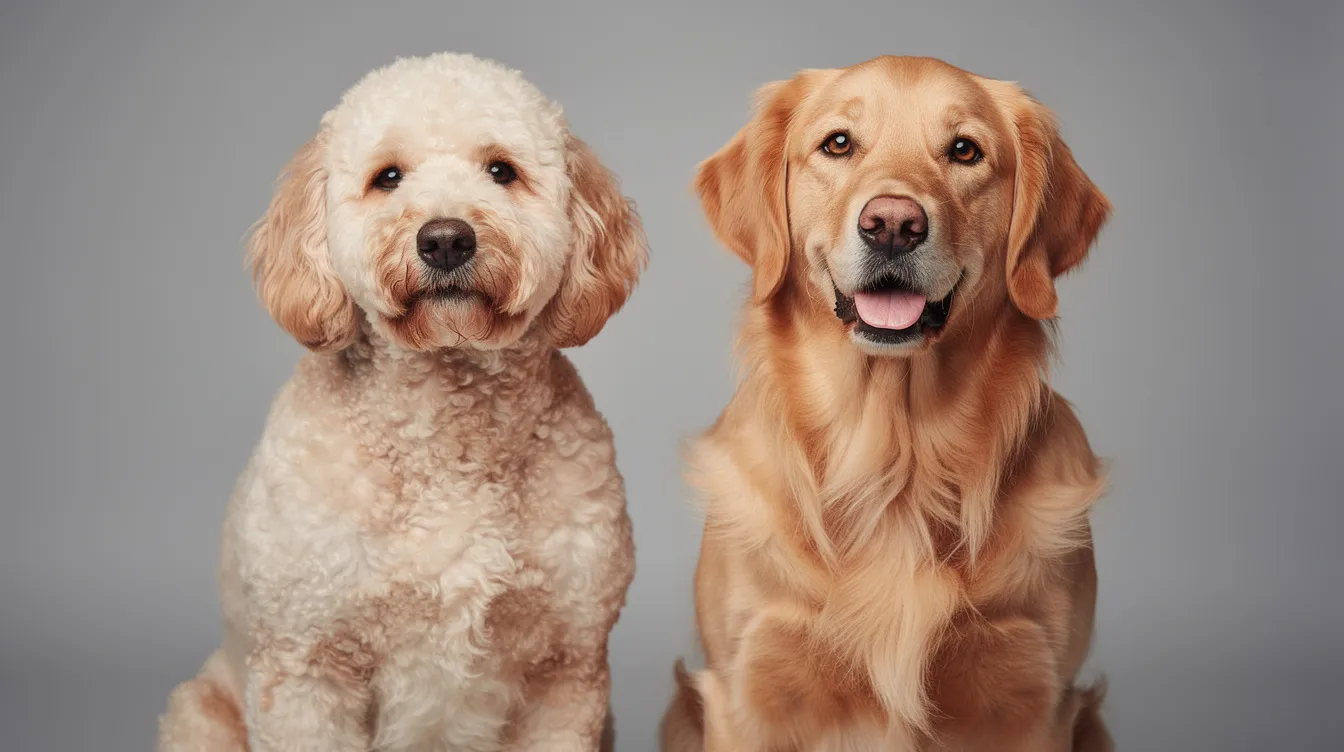
Choosing between a Goldendoodle vs Golden Retriever comes down to how much variability you can accept in temperament, coat maintenance, and training approach. These two breeds share deep genetic roots-every Goldendoodle carries Golden Retriever DNA-but they differ meaningfully in predictability, grooming demands, and behavioral tendencies that directly affect daily life with your dog.
This guide covers the key differences between these two breeds across origins, physical characteristics, training considerations, grooming requirements, exercise needs, and family suitability. It does not dive into detailed health conditions or breeding-specific genetics beyond what’s relevant to ownership decisions. The comparison is written with dog owners in the Greenville, SC area in mind, where climate, lifestyle, and access to professional training shape which breed fits best.
Here’s the direct answer: Golden Retrievers are purebred dogs with a consistent, predictable temperament and a heavy-shedding double coat, making them reliable for obedience training and family life. Goldendoodles are a hybrid dog created by crossing a Golden Retriever with a Poodle, offering a low-shedding coat and varied sizes but introducing significant variability in behavior, energy, and grooming needs.
By the end of this guide, you’ll understand:
- How each breed’s temperament affects training success and family compatibility
- The real grooming commitments each breed demands (and their costs)
- Exercise and mental stimulation requirements for both breeds
- Which breed suits different family situations, living spaces, and lifestyles
- How to access professional training support in Greenville for either breed
Understanding Both Breeds
Whether you’re a first-time dog owner or have years of experience with large dogs, understanding each breed’s background matters. Breeding history directly shapes how a dog learns, how it responds to correction, and what kind of training commitment you’re signing up for. These two breeds share a lineage but diverge sharply in consistency and predictability.
Golden Retriever Fundamentals
The Golden Retriever originated in the Scottish Highlands during the mid-19th century as a hunting dog bred to retrieve waterfowl. Breeders selected for a soft mouth, endurance, water tolerance, and a cooperative disposition-traits that remain central to the breed today. The result is a muscular, medium-to-large dog with a dense, water-resistant double coat and an instinct to work closely with humans.
The American Kennel Club has recognized the Golden Retriever since 1925, and decades of standardized breeding have produced remarkably consistent physical and behavioral traits. Males typically stand 23–24 inches at the shoulder and weigh 65–75 pounds; females are slightly smaller at 55–65 pounds. Coat colors range from light cream to deep golden, and the temperament golden retrievers are known for-friendly, eager to please, patient-is one of the most reliable of any dog breed.
That consistency is precisely what makes Golden Retrievers excellent candidates for obedience training, therapy dogs, and service dogs. Research using the Canine Behavioral Assessment and Research Questionnaire (C-BARQ) has identified specific genetic loci associated with trainability in Golden Retrievers, confirming that their cooperative nature has a strong heritable basis. This predictability extends to energy levels, social behavior, and response to structured training, making them wonderful family pets for households that want consistency.
Goldendoodle Fundamentals
The Goldendoodle emerged in the 1990s as breeders crossed Golden Retrievers with Poodles-typically a Standard Poodle, though Miniature and Toy Poodle crosses produce smaller variants. The goal was to combine the Golden Retriever’s affectionate nature with the Poodle’s intelligence and low-shedding coat, creating an allergy-friendly coat option for families who love retrievers but struggle with heavy shedding.
The trade-off is a lack of breed standardization. Because the Goldendoodle is a mixed-breed dog, not recognized by the American Kennel Club, traits vary substantially depending on the Poodle parent size, generation (F1, F1B, multigenerational), and individual genetics. Two dogs from the same litter can differ in coat texture, adult size, energy level, and behavioral tendencies. Goldendoodle puppies from an F1B cross (backcrossed to a Poodle) tend to carry more Poodle genes and often have curlier, lower-shedding coats, while F1 crosses may shed more like a standard Golden Retriever.
This variability extends to temperament. Goldendoodles tend to inherit intelligence from both parent breed lines-the Poodle is among the most highly intelligent breeds-but may also inherit the Poodle’s sensitivity, alertness, and occasionally higher stranger-directed caution. A 2020 behavioral study of 2,378 dogs found that Goldendoodles scored differently from both parent breeds on several C-BARQ measures, including higher dog-directed aggression and stranger-directed fear. This doesn’t make them difficult dogs, but it does mean training approaches must account for greater individual variation.
Physical Characteristics and Training Implications
A dog’s size, coat type, and energy output aren’t just cosmetic considerations-they directly determine what training equipment you need, how you structure exercise, and what grooming habits you’ll build into your weekly routine. Here’s how these two breeds compare on the physical traits that matter most for training and daily life.
Size and Build Differences
Golden Retrievers typically weigh between 55–75 pounds, with males at the upper end and females toward the lower. Their build is consistent: strong, muscular, deep-chested, with medium-length legs. This predictability means you can plan for crate sizes, collar and harness selection, and the physical strength needed for leash handling.
Goldendoodles can weigh between 15–90 pounds depending on size class. Standard Goldendoodles commonly reach 50–90 pounds and stand 22–24 inches tall. Medium Goldendoodles fall in the 30–50-pound range, while Mini Goldendoodles weigh 15–35 pounds. This variability matters for training: a 25-pound mini requires different handling equipment and force management than a 75-pound standard. Larger Goldendoodles need stronger harnesses and more handler strength for leash work, while smaller ones require gentler corrections and more delicate handling.
In Greenville’s warm climate, size also affects heat tolerance. Both large breeds and thick-coated dogs require shade, hydration breaks, and early-morning or evening training sessions during summer months when temperatures regularly exceed 90°F.
Coat Types and Grooming Impact
Golden Retrievers have a double coat-a dense undercoat beneath a flat or slightly wavy outer coat with feathering on the legs, chest, and tail. They shed year-round and require occasional professional grooming, with heavier shedding during spring and fall seasonal molts. Golden Retrievers require brushing 2–3 times per week to manage loose hair and prevent matting, particularly around the floppy ears where moisture can accumulate and lead to infections.
Goldendoodle coat types vary from straight to wavy to curly, depending on how many poodle genes influence the coat. Goldendoodles shed significantly less than Golden Retrievers-especially those with curlier coats-but this comes at a cost. Goldendoodles require professional grooming every 6–8 weeks and need brushing at least every other day to prevent matting. Goldendoodles can mat easily if not brushed regularly, and those mats trap moisture against the skin, creating conditions for irritation and infection. In Greenville’s humid climate, this risk is amplified.
A critical training consideration: grooming tolerance must be taught early. Goldendoodles often require high-maintenance grooming to prevent matting, which means puppies need socialization to clippers, scissors, brushes, and handling of paws and ears from their first weeks. A visit to a professional groomer shouldn’t be the first time your dog experiences these tools. Golden Retrievers generally tolerate grooming more readily, but their heavy coat still demands consistent brushing to stay manageable.
Goldendoodles are often marketed as hypoallergenic but can still shed. Coat type is the determining factor-curly coats shed least, while straighter coats behave more like a Golden Retriever’s. Prospective owners with allergies should spend time with both parents and the puppy before committing.
Exercise and Energy Requirements
Both breeds need 30–60 minutes of exercise daily at minimum, with most adults thriving on 45–60 minutes of purposeful activity. Both breeds enjoy swimming, hiking, and playing fetch-activities well-suited to Greenville’s parks, trails, and greenways.
Golden Retrievers typically need 45–60 minutes of daily activity and follow more predictable energy patterns. They’re high energy through about age two, then gradually settle into a more consistent routine, making them well-suited to structured training schedules. Insufficient exercise commonly leads to destructive behavior, hyperactivity, and difficulty focusing during training sessions.
Goldendoodles often require more mental stimulation than Golden Retrievers. The intelligence from the Poodle side means these dogs get bored faster with repetitive physical exercise alone. Puzzle toys, scent work, training games, and varied activities are essential to keep Goldendoodles engaged. Standard Goldendoodles need similar physical exercise to Golden Retrievers (60–90 minutes daily), while minis and mediums may need 45–60 minutes but still require substantial mental stimulation to prevent boredom-driven behaviors.
Training and Behavioral Considerations
Both breeds are highly trainable, but their learning styles differ enough to warrant different approaches. Understanding these differences before your first puppy training session sets realistic expectations and accelerates progress.
Trainability and Learning Styles
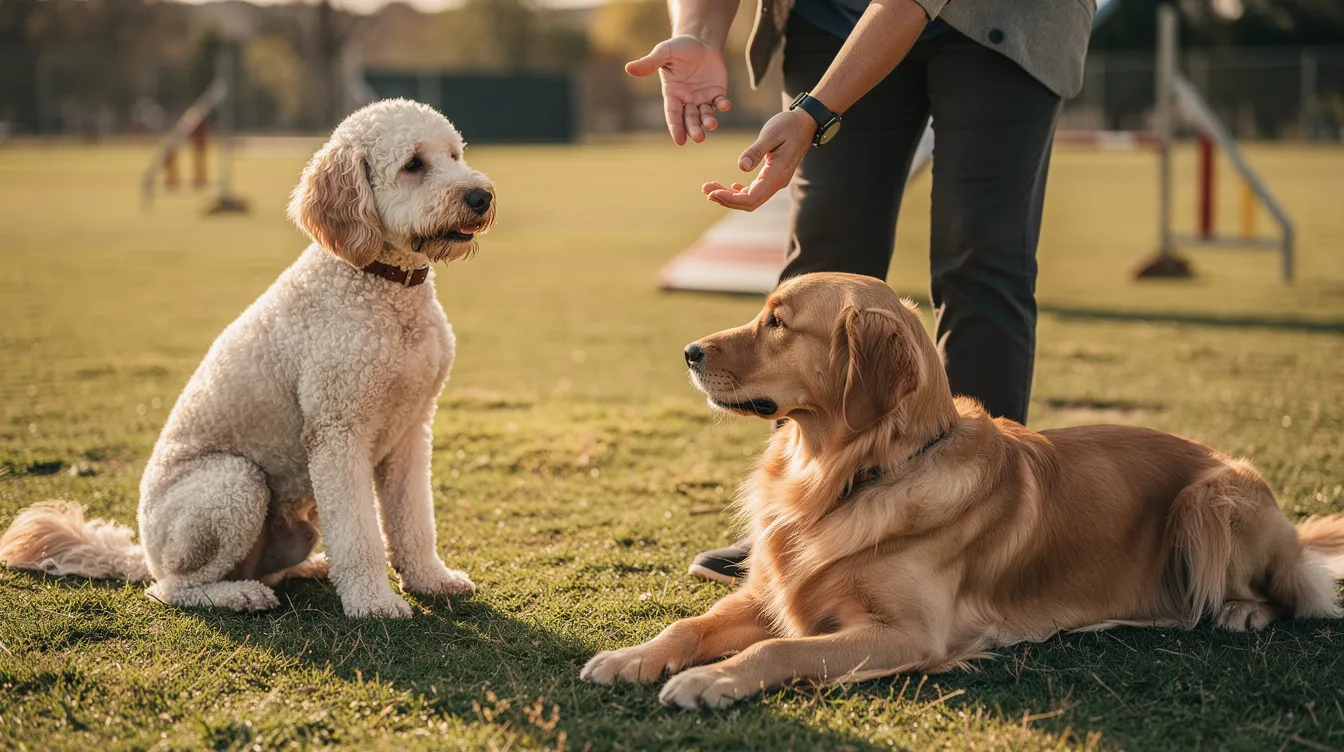
Golden Retrievers learn through consistency, repetition, and clear positive reinforcement. Their eager-to-please nature makes basic obedience straightforward-sit, stay, come, and heel tend to come quickly when paired with reward-based methods. Golden Retrievers are extremely loyal and eager to please, which translates to strong recall instincts and willingness to follow handler cues. This is why they consistently rank among top breeds for service animals and therapy dogs. Golden Retrievers may have a slight edge in obedience training compared to Goldendoodles, particularly in structured environments.
Goldendoodles are super smart, but that intelligence creates a different training dynamic. They learn commands quickly-sometimes after just a few repetitions-but bore easily with repetitive drills. Engaging sessions with variety, cascadable tasks (tricks building on tricks), and high-value rewards keep their attention. Goldendoodles are sensitive and highly trainable like Golden Retrievers, but those with more Poodle genes may require more nuanced correction and respond negatively to harsh tones or forceful handling. Both breeds respond well to positive reinforcement training techniques.
Off-leash training differs between the two breeds. Golden Retrievers often excel in recall because their retrieving instinct naturally brings them back to the handler. Goldendoodles’ variability means some have excellent recall while others are more easily distracted by novel stimuli-squirrels, other dogs, unfamiliar people. Advanced obedience training with solid distraction-proofing is especially important before any off-leash work with Goldendoodles.
Recommended training timeline for both breeds:
- 8–12 weeks: Begin socialization and basic commands (sit, name recognition, gentle handling)
- 3–6 months: Consistent leash skills, crate training, exposure to new environments and people
- 6–12 months: Impulse control, separation conditioning, more complex commands
- 12–24 months: Distraction-proof recall, off-leash readiness, advanced obedience
Both breeds typically reach behavioral maturity around 18–24 months, though smaller Goldendoodles may mature slightly earlier.
Behavioral Traits Comparison
A side-by-side comparison based on C-BARQ behavioral data, breed standard descriptions, and specialist observations reveals meaningful differences between these wonderful dogs:
| Trait | Golden Retriever | Goldendoodle |
|---|---|---|
| Attention Span | Steady and consistent during training; maintains focus when motivated | Can be high but drops quickly with repetitive tasks; needs variety |
| Distractibility | Moderate; may get excited by new environments or wildlife | Higher potential; may react strongly to novel stimuli, especially with strong Poodle influence |
| Social Behavior | Excellent with children and other pets; friendly toward strangers | Generally social, but Goldendoodles can be more cautious around strangers due to Poodle traits |
| Independence Level | Low independence; seeks human guidance; may develop separation anxiety | Variable; some display more independence while others show higher separation anxiety |
| Response to Correction | Responsive and forgiving; thrives with positive reinforcement | More sensitive; requires gentler correction; may shut down with harsh handling |
Goldendoodles can demonstrate variability in temperament and behavior, which means the table above represents tendencies rather than guarantees. Individual assessment-ideally through a free phone consultation with a professional trainer-is always more reliable than breed generalizations.
Golden Retrievers are generally excellent with children and other pets, earning their reputation as great family pets. Their affectionate nature and patience make them a natural fit for households with young kids. Goldendoodles share much of this warmth but may need more structured introductions to new people and other dogs, particularly if early socialization was limited.
Common Training Challenges and Solutions
Every dog breed comes with specific training hurdles. Knowing what to expect-and having solutions ready-prevents small issues from becoming entrenched behavioral problems.
Golden Retriever: Overexcitement and Jumping
Golden Retrievers greet the world with enthusiasm, which often manifests as jumping, mouthiness, and full-body excitement. At 55–75 pounds, this isn’t just annoying-it can knock over children and elderly visitors. The underlying issue is impulse control, not disobedience.
Solutions focus on rewarding calm behavior rather than punishing excitement. Teach “sit for greeting” early and enforce it consistently-attention only comes when all four paws stay on the floor. Redirect excited energy into acceptable outlets like fetch or tug before guests arrive. Crate training provides a structured cool-down space during high-stimulation moments. These techniques align with the positive reinforcement methods used in basic obedience programs.
Goldendoodle: Inconsistent Focus and Distraction
The Goldendoodle’s intelligence-inherited from both parent breed lines-can work against training when sessions are repetitive or understimulating. Larger Standard Goldendoodles may combine high energy with impulsivity, while smaller varieties may develop excessive barking or reactive behavior when bored.
Keep training sessions shorter (10–15 minutes) but more frequent. Rotate through commands and integrate novel challenges: scent games, agility exercises, puzzle toys, and trick sequences. Use variable reward schedules to maintain engagement. For persistent focus issues, a professional trainer can design structured mental stimulation plans that channel intelligence productively rather than letting it manifest as distraction.
Both Breeds: Separation Anxiety Prevention
Both Goldendoodles and Golden Retrievers are deeply people-oriented, making separation anxiety a common concern-particularly in Greenville, where many owners work standard 8–5 schedules. Research shows Goldendoodles may score higher on separation-related distress metrics than their parent breeds.
Prevention starts early:
- Crate train from puppyhood: Make the crate a positive, safe space with treats and comfort items
- Desensitize departure cues: Practice picking up keys, putting on shoes, and touching door handles without leaving
- Build alone time gradually: Start with 5-minute absences and extend systematically
- Provide enrichment: Interactive feeders, frozen Kongs, and puzzle toys keep dogs occupied during absences
- Consider professional help: If signs escalate (destructive behavior, excessive vocalization, house soiling), an aggressive dog or anxiety behavior specialist can intervene before patterns solidify
Local resources like dog walkers and doggie daycare in the Greenville area can supplement training by breaking up long isolation periods.

Choosing the Right Breed for Your Family
The right choice between a Goldendoodle vs. a Golden Retriever depends on your lifestyle, tolerance for variability, and willingness to invest in grooming and training.
Choose a Golden Retriever if you want a predictable temperament, don’t mind heavy shedding, have space for large dogs, and value straightforward obedience training. They’re ideal for an active family with children, for those interested in dog sports or therapy dog preparation, and for households where a reliable, consistent companion matters most. Golden Retrievers have an average lifespan of 10–12 years. Golden Retriever puppies cost $500–$3,000 from quality breeders, and health screenings are recommended for breeding Golden Retrievers to ensure quality.
Choose a Goldendoodle if allergies are a concern (noting that a low-shedding coat isn’t guaranteed), you prefer size flexibility from mini to standard, or you enjoy the creative challenge of training dogs with high intelligence. Goldendoodles are wonderful dogs for families willing to invest in regular professional grooming and varied mental stimulation. Goldendoodles typically live 12–15 years on average, and Goldendoodles may have fewer inherited health risks due to hybrid vigor-though this depends heavily on reputable breeders who perform genetic testing and health testing on parent animals. Goldendoodle puppies range from $1,500 to $5,000+ depending on lineage.
Financial reality for both breeds: Lifetime costs for both breeds are around $15,000–$20,000. Goldendoodles require more grooming, increasing long-term costs through regular visits to a professional groomer. Golden Retrievers offset lower grooming costs with higher cleaning expenses from year-round shedding. Both breeds are prone to joint and eye conditions, including hip dysplasia and elbow dysplasia, making regular vet visits essential for both breeds’ health.
Climate considerations for Greenville: Both breeds can struggle in Greenville’s hot, humid summers. Heavy double-coated Golden Retrievers and thick-coated Standard Goldendoodles need shade, cooling mats, and indoor time during peak heat. Schedule walks and training sessions for early morning or late evening, and always check pavement temperature before long walks.
Immediate next steps:
- Schedule a free phone consultation to discuss which breed matches your family’s situation
- If you already have a puppy or dog, book an evaluation session to develop a customized training plan
- For either breed, begin socialization and basic obedience early-ideally before 16 weeks of age
- Research therapy dog preparation if you’re considering a service or therapy role for your dog
Professional Training Support in Greenville
Both Golden Retrievers and Goldendoodles thrive with professional guidance-especially during the critical first year. Off Leash K9 Training – Greenville offers specialized programs for both breeds, including private lessons tailored to breed-specific challenges, comprehensive board and train programs for intensive obedience development, and behavior modification for dogs showing fear, reactivity, or aggression patterns.
For Goldendoodles with unpredictable traits or households managing multiple dogs, board and train programs provide structured environments where trainers can work through behavioral variability without the distractions of home life. For Golden Retrievers, private lesson packages build on their natural eagerness to please, channeling that enthusiasm into reliable off-leash obedience.
Whether you’re comparing your first golden doodle vs golden retriever, managing a high-energy puppy, or working toward off-leash reliability with either breed, professional training accelerates results and prevents small issues from becoming serious behavioral problems. View training packages and pricing or watch training results videos to see both breeds in action.