
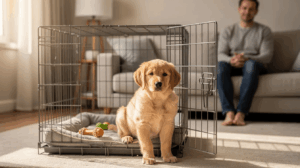
How much crate time should a puppy have? For puppies under six months, Humane World for Animals recommends no more than three to four hours in a crate at one time during the day. Very young puppies usually need much shorter stretches because bladder control, feeding, play, and sleep needs change quickly.
Treat three to four hours as an upper limit for older puppies under six months, not a daily target. A crate should support safe rest and management, not become where a puppy spends most of the waking day.
Crate Time Depends on Age and the Individual Puppy
There is no schedule that fits every puppy. Bladder control, health, crate experience, activity, and comfort also matter.
Owners often hear the “age in months plus one” rule for bladder capacity. That is a rough planning tool, not a recommendation to keep a puppy crated for the entire period.
VCA’s puppy housetraining guidance recommends frequent potty opportunities after waking, meals, drinking, and energetic play. A puppy may need to go out long before a bladder-capacity estimate suggests.
Practical Crate-Time Guidance by Age
8–10 Weeks
Keep daytime crate sessions short. AKC’s puppy alone-time guidance uses about one hour as an alone-time guideline for puppies under ten weeks.
Take your puppy out after waking, meals, drinking, play, before crating, and immediately after release.
10–12 Weeks
AKC uses about two hours as a general alone-time guideline for puppies from ten to twelve weeks. Some puppies need to go out sooner. Build a calm routine rather than testing the maximum confinement time.
3–5 Months
Longer stretches may become possible as bladder control improves. Even so, Humane World recommends that puppies under six months not remain crated for more than three to four hours at a time during the day.
Schedule earlier potty breaks after food, water, naps, play, or training.
6 Months and Older
Older puppies may tolerate longer periods alone, but alone time and closed-crate time are not exactly the same.
If your workday requires a long absence, a midday break, exercise pen, or puppy-safe room can be more appropriate than simply increasing crate confinement.
Daytime Crating vs. Overnight Sleep
Nighttime sleep is different from daytime confinement.
A sleeping puppy may go longer between bathroom trips than an awake puppy, but young puppies may still need overnight potty breaks.
If your puppy wakes, becomes restless, or begins to vocalize after sleeping, a calm bathroom trip may be appropriate. Go outside, give the puppy a chance to eliminate, and return to the sleeping area without turning the trip into playtime.
A Healthy Daily Crate Routine
A simple pattern works well:
Wake → potty → activity → potty → rest
Activity can include meals, training, play, socialization, and exploration.
Not every nap needs to happen in a closed crate. Puppies can also learn to relax on a mat, in an exercise pen, or in another puppy-safe area.
A balanced routine includes bathroom breaks, movement, interaction, training, and rest outside the crate.
How to Make Crate Time Comfortable
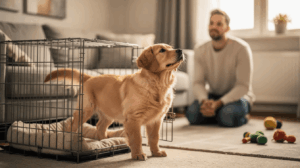
Use a crate large enough to stand, turn around, lie down, and stretch comfortably. An oversized crate can let some puppies eliminate at one end and sleep at the other.
Introduce the crate gradually. Encourage voluntary entry with food, treats, and safe enrichment. Increase closed-door time only as the puppy remains comfortable.
Provide fresh water during the day. Do not restrict water simply to extend crate time.
When Crate Crying Is More Than Protest
Puppies may whine because they need to eliminate, are frustrated, are uncomfortable, or want company.
Brief whining that decreases is different from persistent distress.
Watch for heavy panting unrelated to heat or exercise, excessive drooling, frantic biting or clawing at the crate, repeated escape attempts, persistent howling, or self-injury.
ASPCA’s separation-anxiety guidance cautions that crate confinement can increase distress in some dogs. If your puppy panics, repeatedly tries to escape, or risks injury, end confinement safely and contact your veterinarian or a qualified behavior professional before continuing. Do not wait for silence when your puppy is panicking.
What if You Work a Full Day?
A very young puppy should not be expected to remain continuously crated through an eight-hour workday.
If you will be away longer than your puppy can comfortably manage, consider a trusted family member, pet sitter, dog walker, exercise pen, or puppy-safe room.
Meet the puppy’s needs rather than forcing the crate to fit the owner’s schedule.
Greenville Puppy Training Support
Off Leash K9 Training of Greenville’s puppy programs include crate-training foundations.
Options include Puppy Preschool, One-Week Puppy Board & Train, and Puppy Training Consultations.
The One-Week Puppy Board & Train includes crate training, potty training, bite inhibition, Come, Sit, and limited leash handling.
Professional guidance can help build a practical routine, but results still depend on age, temperament, schedule, and follow-through.
Greenville owners can also review current training programs and pricing or schedule a free consultation.
Frequently Asked Questions
Can an 8-Week-Old Puppy Stay in a Crate for Four Hours?
Four hours is generally too ambitious for a very young puppy. AKC uses about one hour as an alone-time guideline for puppies under ten weeks.
Does Overnight Crate Time Count the Same as Daytime?
Not exactly. Sleeping puppies may go longer between bathroom trips, but young puppies can still need overnight breaks.
Should I Let My Puppy Cry in the Crate?
Check whether your puppy needs a bathroom break or is uncomfortable. Brief, mild whining may settle, but escalating distress, frantic escape attempts, or self-injury require ending confinement safely and contacting your veterinarian. Do not wait for silence when your puppy is panicking.
How Much Total Crate Time Is Too Much?
There is no universal daily total. Focus on whether your puppy still has enough waking time for bathroom breaks, exercise, social interaction, training, exploration, and relaxed time outside the crate.
Final Takeaway
For puppies under six months, three to four hours is a useful daytime upper limit for one crate stretch, but younger puppies need shorter sessions.
Watch the puppy rather than only the clock. Use frequent potty breaks, gradual crate training, adequate activity, and larger safe spaces when your absence exceeds what the puppy can comfortably manage.
Greenville owners can review puppy training programs, training options, or schedule a free consultation for help building an age-appropriate crate routine.