
Introduction
A well-structured puppy crate training schedule is the single most important tool for housetraining success, behavioral development, and building your pup’s confidence. Without a reliable crate schedule, owners face repeated potty accidents, confused puppies, and stalled progress-problems that a consistent, age-appropriate routine solves quickly.
This guide covers age-specific crate and potty schedules from 8 weeks through 6 months, detailed timing guidelines for daytime and overnight crating, sample daily routines for both work-from-home and away-from-home households, and troubleshooting for common scheduling problems. What this guide doesn’t cover in depth: basic crate introduction steps like making the crate inviting or first entries-topics we address separately. The target audience is new puppy owners, families struggling with scheduling, and anyone in the Greenville, SC area looking for a structured approach to training your dog from day one.
The direct answer: Young puppies at 8–12 weeks old need crate intervals of roughly 2–3 hours maximum during the day, with a potty break after every nap, meal, and play session. As a puppy grows, you gradually increase crate time-puppies can hold their bladder for one hour per month of age, so a 3-month-old manages about 3–4 hours, and a six-month-old puppy can typically hold it for up to six hours. Overnight stretches develop more slowly, but most puppies sleep through the night by 4–6 months.
Here’s what you’ll gain from this article:
- Precise timing intervals for crate sessions and potty breaks at every puppy age
- Complete age-appropriate schedules you can start using today
- Sample daily routines for working-from-home and working-outside-home households
- Proven troubleshooting methods for crying, accidents, and crate resistance
- Long-term strategies for transitioning to an adult dog routine
Understanding Puppy Development and Crate Training Fundamentals
Puppy development stages directly dictate how you structure a crate schedule. A structured crate training timeline helps puppies view their crate as a safe den-but only when the timing respects their physical and neurological maturity. At 8–10 weeks, your pup has a tiny bladder, needs enormous amounts of rest, and is highly prone to overstimulation. By 3–4 months, sleep patterns consolidate, and bladder muscles strengthen. Around 5–6 months, many puppies approach adult-level bladder control and can handle longer periods in the crate.
Puppies should be treated individually; some may adjust to crate training faster than others. Breed size matters significantly-small and toy breeds often require more frequent bathroom breaks than larger breeds at the same age. Crate training can take days or weeks to complete, so patience tied to your dog’s age and development stage is essential. Understanding these fundamentals puts you on the right track before building any schedule.
Puppy Sleep and Rest Requirements
Puppies need 18–20 hours of sleep daily during their earliest weeks. At 8–10 weeks old, your puppy is awake only about 30–60 minutes at a time before needing to fall asleep again. This rest time isn’t optional-naps support immune function, brain development, and behavior regulation. An overtired puppy is more reactive, less able to self-settle, and far more likely to have potty accidents in the crate.
As your puppy grows, sleep needs decrease gradually: around 16–18 hours at 3–4 months, roughly 14–16 hours at 5–6 months, and approximately 12–14 hours by the first birthday. Overnight sleep stretches start fragmented-expect wake-ups every few hours for young puppies-and gradually lengthen as bladder control improves. Planning crate naps during the day ensures your pup gets enough rest and keeps the crate training process moving forward smoothly.
Bladder Control Development Timeline
Bladder control is the biological constraint that shapes every crate schedule. The widely accepted rule: a puppy can hold their bladder for roughly one hour per month of age during the day-but treat this as a ceiling, not a target. Here’s the progression:
- 8–10 weeks old (~2 months): A 10- to 12-week-old puppy can hold it for about two hours, though when actively awake, realistic intervals are closer to 45–60 minutes.
- 3 months: Approximately 3–4 hours maximum.
- 4 months: Around 4–5 hours.
- 5–6 months: A six-month-old puppy can typically hold it for up to six hours. Puppies under six months should not be crated over four hours during the day.
- Adult dogs: Adult dogs can be crated for up to six hours during the day and can stay in their crate overnight for up to eight hours.
Overnight is different from daytime. During sleep, metabolism slows and bladder function is reduced, meaning puppies can often hold it a bit longer at night than their daytime maximum suggests. By 4–6 months, many puppies sleep through the night without a potty break-provided you’ve been consistent with the earlier nighttime schedule.
Understanding this developmental timeline is what makes the difference between a realistic crate schedule and one that sets both you and your puppy up for frustration.
Creating Your Age-Appropriate Crate Training Schedule
Now that you understand how bladder control and sleep needs evolve, you can build a crate schedule tailored to your puppy’s specific age. Crate training schedules should include playtime and potty breaks-never just confinement. Establish predictable transitions between crate time and potty times for effective potty training. The key at every stage: potty break immediately after waking, after eating, and after play-then crate for a calm nap.
8–12 Week Old Puppy Schedules
At 8–12 weeks old, your new puppy needs short periods of crate time-typically 30–60 minutes during daytime awake windows. Awake periods themselves are brief, often just 45–60 minutes before your pup needs another nap.
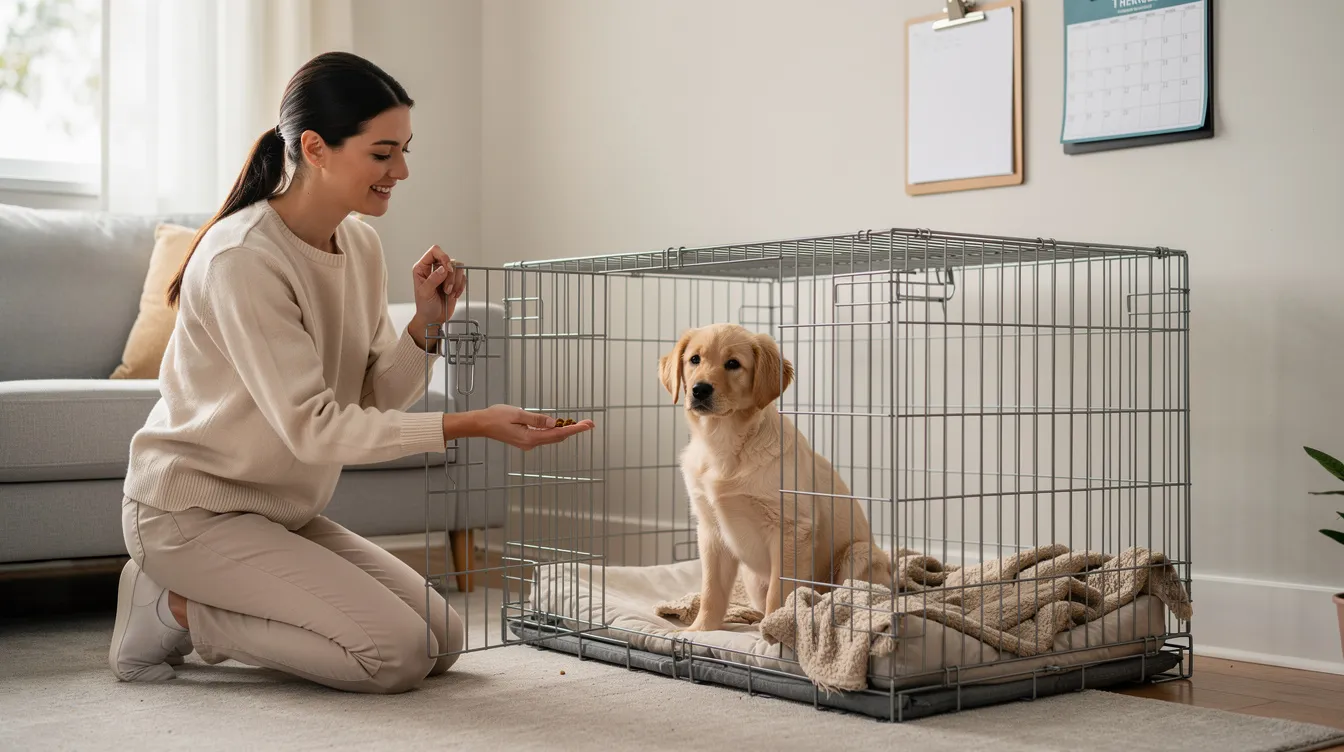
Introduce the crate by placing treats inside it. Feed your dog meals in the crate to create positive associations-you can place the food dish inside with the crate door open to build positive associations without pressure. Gradually increase crate time to help your dog adjust, starting with just half an hour and working upward as your puppy settles.
Sample 8–12 week schedule:
- 6:00 AM – Wake, immediate potty break outside
- 6:15 AM – First meal (breakfast in or near crate)
- 6:30 AM – Potty break, then short play or training (10–15 min)
- 7:00 AM – Crate nap (45–60 min)
- 8:00 AM – Wake, potty break, supervised play
- 8:30 AM – Crate nap (45–60 min)
- Repeat cycle through midday with potty breaks, meals, short play, crate naps
- 5:00 PM – Dinner, potty break, calm play
- 7:00 PM – Final water access; calm evening routine
- 8:30 PM – Last potty break, overnight crate (beside your bed)
- Overnight – Expect 2–3 wake-ups for potty; set alarm if needed
At this age, you may need 10–14 potty breaks per day. Puppies should not be crated for more than three to four hours, and realistically these very young puppies need breaks far more often when awake. Reward calm behavior and avoid using the crate as punishment-this is one of the most important things you can teach early on.
3–4 Month Old Puppy Schedules
As bladder control improves, daylight crate intervals extend to roughly 2 hours between breaks. Naps become fewer and longer. Your potty schedule tightens to about 8–10 breaks per day, and meals typically drop from four to three per day.
Key adjustments at 3–4 months:
- Crate sessions extend to 1.5–2 hours during the day
- Overnight stretches may reach 5–6 hours
- Training and socialization sessions become more effective
- Enrichment inside the crate-a bully stick, safe chew toy, or frozen treat-helps your pup settle for longer periods
- Evening calm routines begin: lower stimulation, less play before bed
Balance crate time with supervised free time in the house. This is where the daily routine starts taking a recognizable shape-your puppy is learning to sit, stay calm, and spend time resting independently. Dogs should not be crated all day as they need frequent bathroom breaks and exercise, so ensure supervised exploration and enough exercise are woven into the schedule.
5–6 Month Old Puppy Schedules
By 5–6 months, daytime crate sessions can extend to 3–4 hours maximum. A six-month-old puppy can typically hold it for up to six hours, though you shouldn’t push this limit routinely during the day. Overnight, most puppies now sleep 6–8 hours without interruption. Potty breaks drop to about 5–6 per day, and meals settle to 2–3 daily.
From this point, the schedule starts shifting toward an adult routine. The crate remains a helpful tool-used when you’re away, for rest time after high-energy activity, or as a safe place during dinner or when kids are running through the room-but it’s no longer the constant management tool it was during the first few months. Make the crate inviting by using treats and keeping it clean and comfortable for the puppy, even as your dog needs it less frequently.
This transitional period is also where past experiences with the crate pay off. A puppy who has had consistent, positive crate associations adjusts easily to longer periods and eventually treats the crate as their preferred bed.
Sample Daily Schedules and Implementation Methods
Age-specific guidelines give you the framework; now let’s put them into practical daily routines you can actually follow. The right schedule depends on your lifestyle-whether you work from home or away-and must account for your puppy’s age, breed, and individual temperament.
Working from Home Schedule
Working from home gives you the most flexibility to maintain frequent potty breaks and short crate intervals. Here’s a sample for a 3–4-month-old puppy:
- 6:30 AM – Wake, first thing outside for potty
- 6:45 AM – Breakfast (in crate or near it)
- 7:00 AM – Potty break, then 15-minute walk or play session
- 7:30 AM – Crate nap (1.5–2 hours) while you work
- 9:30 AM – Potty break, training session (10 min-practice sit, reward with a treat)
- 10:00 AM – Crate rest with a chew toy
- 12:00 PM – Lunch meal, potty break, supervised play
- 12:30 PM – Crate nap (1.5–2 hours)
- 2:30 PM – Potty break, exercise and enrichment
- 3:00 PM – Supervised free time or crate with enrichment
- 5:00 PM – Dinner, potty break, longer walk or play
- 6:00 PM – Calm supervised time in the house
- 7:30 PM – Remove water, final calm play
- 8:30 PM – Last potty break, overnight crate
Flexibility points: If a work call runs long, extending a crate session by 15–20 minutes occasionally won’t derail progress. Use micro-sessions of alone time even when you’re home-close the crate door for short periods while you’re in another room to help prevent separation anxiety from developing.
Working Outside Home Schedule
When you’re away 8–9 hours, the schedule requires more planning and external support. Puppies under 16 weeks absolutely need a midday visit from a pet sitter, dog walker, or trusted neighbor. Even older dogs benefit from a midday break.
- 5:30 AM – Wake, immediate potty break
- 5:45 AM – Breakfast, potty break
- 6:00 AM – Longer walk or play to drain energy (20–30 min)
- 6:30 AM – Final potty, crate with enrichment toy
- ~12:00 PM – Midday visit: potty break, short walk, lunch if applicable, fresh water
- 12:30 PM – Back in crate with chew or bully stick
- 5:00 PM – Arrival home: immediate potty break, exercise
- 5:30 PM – Dinner, potty, training session
- 7:00 PM – Supervised free time, calm play
- 8:30 PM – Remove water, last potty break, overnight crate
Critical note: If you cannot arrange a midday break for a puppy under 4 months, consider a larger puppy-proofed area with the crate door open and a bathroom pad rather than locking your pup in the crate for the full workday. Dogs should not be crated all day-they need frequent bathroom breaks and exercise.
Schedule Comparison Table
| Factor | Working from Home | Working Outside Home |
|---|---|---|
| Max single crate block | 1.5–2 hours (3–4 mo pup) | 3–4 hours with midday break |
| Potty breaks per day | 8–10+ | 5–7 (with sitter help) |
| Exercise timing | Multiple short sessions | Concentrated AM and PM |
| Supervision quality | Frequent check-ins | Relies on external support |
| Enrichment needs | Moderate (breaks available) | High (must occupy longer periods) |
| Separation anxiety risk | Higher if no alone-time practice | Lower with routine, higher if no midday relief |
Both you and your puppy benefit most from consistency. Whichever schedule you follow, maintain the same core anchor times-wake, meals, bed-even on weekends. This predictability is what makes puppies well-behaved and confident.
Common Scheduling Challenges and Solutions
Even the best-planned schedule hits obstacles. Here’s how to address the most frequent issues without abandoning your routine.
Puppy Crying During Scheduled Crate Time
Crying or barking during crate time usually signals an overtired puppy, crating too soon after high arousal, or insufficient positive association with the crate. First, check that you’ve followed the potty-then-crate sequence-if your pup’s bladder is empty and they’ve had exercise, the cry is usually about settling.
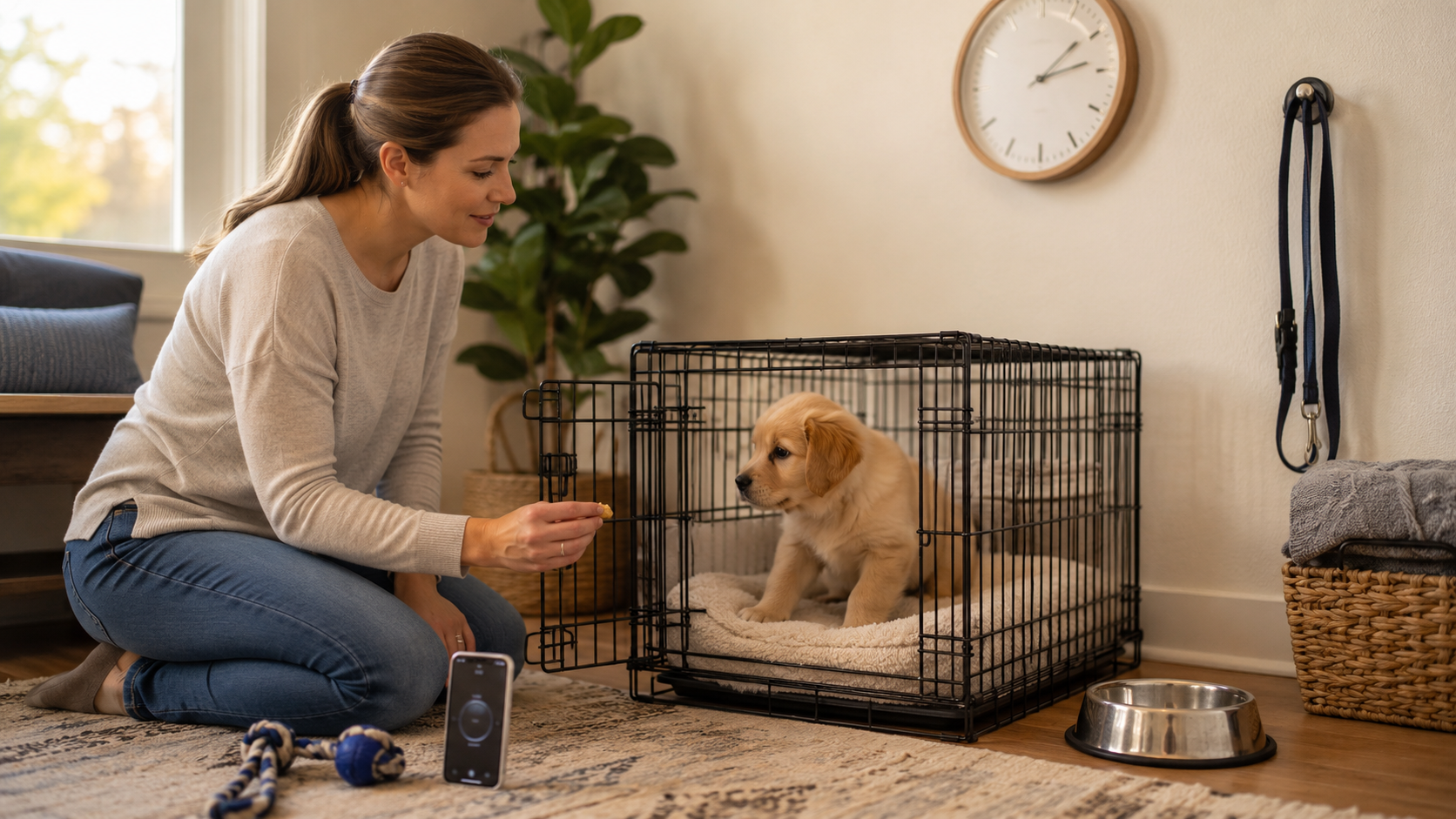
Ignore whining to avoid reinforcing anxious behavior in puppies during crate training. Wait for even a brief moment of calm, then reward with quiet praise. If crying persists beyond 10–15 minutes at every session, shorten crate time back to a duration where your puppy succeeds, then increase by 5–10 minute increments. A helpful tip: place a worn t-shirt in the crate so your scent provides comfort.
Inconsistent Potty Accident Timing
Potty accidents often follow a pattern. Track exactly when accidents happen-many owners discover they’re missing the post-meal or post-nap potty break window. Tighten your potty schedule: take your puppy out within 5 minutes of waking, within 10 minutes of eating, and immediately after play.
Make the crate small enough that your puppy doesn’t want to soil the sleeping area-use a divider if needed. With consistent timing, most puppies show dramatic improvement within 1–2 weeks, and many are reliably housetrained by 4–6 months. Don’t forget to praise immediately when elimination happens outside.
Resistance to Longer Crate Periods
When you start extending crate sessions and your puppy scratches, paces, or whines, you’ve likely increased duration too quickly. Gradually increase crate time-add 10–15 minute increments rather than jumping from one hour to three. Ensure pre-crate activity includes a potty break and calming walk or mental stimulation, and place a safe chew or frozen treat inside.
Watch for stress signals: excessive drooling, panting, or attempts to escape. If these appear, return to a shorter duration where your puppy is comfortable and rebuild more slowly. For older dogs or puppies approaching 6 months, resistance may signal they need more exercise or mental stimulation rather than a schedule problem.
Schedule Conflicts with Family Routine
Real life rarely cooperates with a perfect puppy schedule. Map your family’s routine-work, school, activities-and identify who handles each potty break and feeding. Assign responsibilities clearly so nothing gets missed. Where unpredictable days occur, maintain core anchor times: first thing in the morning potty, meal times, and last potty before bed.
If schedule gaps are unavoidable, professional training support can help you develop a realistic plan. Consider a dog walker or pet sitter for midday coverage, and communicate with everyone in the house so the puppy gets consistent handling. Teach kids to follow the routine too-consistency from the whole family accelerates progress dramatically.
Conclusion and Next Steps
A successful puppy crate training schedule comes down to three principles: respect your puppy’s age-related bladder and sleep needs, maintain consistent daily routine timing, and increase crate durations gradually as your puppy demonstrates readiness. The crate training process isn’t about confinement-it’s about creating a safe way for your puppy to rest, learn self-control, and develop the calm confidence that supports everything from potty training to advanced obedience.
Your immediate next steps:
- Determine your puppy’s age bracket and select the corresponding schedule from this guide
- Set specific times for potty breaks, meals, and crate sessions-write them down
- Track accidents and successes for the first two weeks to identify patterns
- Adjust intervals based on your puppy’s individual progress, not just general guidelines
- Build in alone-time practice to prevent separation anxiety, even if you work from home
As your puppy matures, the crate becomes a foundation for more advanced goals-including off-leash reliability, impulse control, and calm behavior in varied environments. If you’re in the Greenville, Spartanburg, or Greer area and want a personalized schedule built around your household, Off Leash K9 Training – Greenville, SC offers consultations and board-and-train programs designed to accelerate your puppy’s progress.
Additional Resources
Signs of successful crate training progression:
- Your puppy enters the crate voluntarily and can fall asleep within a few minutes
- Potty accidents decrease week over week
- Overnight sleep stretches lengthen without wake-ups
- Your puppy remains calm when the crate door closes
- Crate time no longer triggers barking or distress
Schedule tracking: Keep a simple log of wake times, potty breaks, meals, and crate sessions for the first month. This data reveals patterns-like a consistent 2:00 PM accident-that a quick schedule adjustment can fix.
Professional guidance: For personalized puppy training plans, view available packages and pricing or check our FAQ for answers to common training questions.
